Rudheq: A Futuristic Display Font for Handmade Creators
There’s that moment—right after you’ve poured your third soy wax blend, wiped candle wax off your counter, and opened your design software to finalize the label. You stare at the placeholder text: “Lavender Sky.” It feels flat. Generic. Like it’s whispering instead of announcing. That’s when I first tried Rudheq.
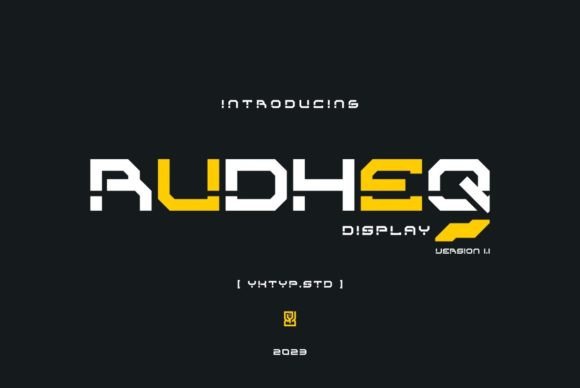
Rudheq isn’t just another modern font—it’s a display typeface with quiet confidence and sleek intention. Its letterforms balance geometric precision with subtle organic flow: clean terminals, gentle tapering strokes, and just enough character to feel human without sacrificing clarity. It’s futuristic, yes—but not cold. Not robotic. Think warm minimalism meets editorial polish. The kind of font that makes “Small Batch • Hand-Poured” look like a promise, not a disclaimer.
I tested Rudheq across real handmade contexts—not mockups in theory, but actual production moments. On matte-finish candle labels printed at home? Crisp, even at 8 pt. On kraft paper gift tags laser-cut with my Silhouette? No jagged edges, no lost detail. On a digital printable wall art set I designed for spring—featuring soft watercolor blooms and minimalist quotes—Rudheq anchored each piece with grounded elegance. It didn’t compete with the illustration; it complemented it.
What makes Rudheq especially useful for makers is its natural fit for short, high-impact text. It shines on product names (“Hearth & Ember”), boutique tags (“Handmade in Oregon”), wedding welcome boards (“You’re Here”), planner cover titles (“Slow Season Planner”), or sticker sheet headers (“Joyful Notes • Gratitude • Quiet Moments”). It’s not built for body copy—but then again, neither are most display fonts. And that’s perfectly okay. In fact, it’s ideal. When you’re designing a greeting card front, a mug wrap, or a seasonal shop banner, you want typography that commands attention in under three seconds. Rudheq delivers that—without shouting.
Readability matters—especially when your designs go from screen to cutting machine to physical object. I ran Rudheq through several real-world checks: scaled down to 6 mm for vinyl sticker sheets (clean cut lines, no inner counters collapsing), set at 14 pt on 2×3” cotton twill tags (legible at arm’s length), and previewed on Etsy listing thumbnails (it held presence even at thumbnail size). For Cricut Design Space and Silhouette Studio users: Rudheq’s clean outlines and open apertures mean smoother vector conversion and fewer manual node adjustments.
Pairing Rudheq thoughtfully elevates your whole design system. I often layer it with a neutral sans serif—like Montserrat Light or Inter Regular—for supporting text on packaging or digital templates. That contrast lets Rudheq breathe while keeping information accessible. For wedding stationery, I’ve paired it with a delicate script font (think a refined, non-cursive connected script) for names and dates—Rudheq handles headings and “RSVP” instructions with calm authority. With farmhouse-style signs or botanical prints? A simple serif like Lora or Playfair Display adds warmth without competing. The key is contrast: weight, style, and purpose—not similarity.
Before using Rudheq commercially—whether on physical products, SVG bundles, printable planners, or Shopify banners—I always double-check what’s included. Does the file package offer OTF and TTF? Are there stylistic alternates or ligatures for customizing words like “love” or “forever”? Is multilingual support present if I’m designing bilingual holiday tags? Most importantly: does the license explicitly allow commercial use for physical goods and digital downloads? Yes—it does. And that peace of mind matters when you’re bundling a set of 12 printable quote cards or prepping a batch of branded tote bags.
Seasonal work is where Rudheq truly flexes its versatility. Last fall, I used it for rustic-chic pumpkin spice candle labels—paired with burnt orange foil accents—and it felt both contemporary and cozy. For spring mini planners, I set “Bloom Slowly” in Rudheq over pastel linen textures. At Christmas, “Gather • Give • Glow” on velvet ribbon tags had a quiet luxury that matched the unboxing experience. It adapts—not by changing shape, but by how it interacts with color, texture, and spacing.
It also works beautifully in digital-first contexts. When designing Canva templates for other makers, Rudheq gives editable title placeholders instant sophistication—no extra styling needed. For Instagram story highlights or Pinterest pin previews, its strong x-height and balanced proportions ensure legibility even on small screens. And because it’s a well-hinted font, it renders cleanly across browsers and devices—critical when sharing downloadable PDFs or web-based printables.
One thing I appreciate about Rudheq as a maker is how it supports brand consistency without demanding uniformity. You can use it across candle labels, thank-you cards, website headers, and packaging tape seals—and it feels like one voice, not a series of disconnected elements. That cohesion helps customers recognize your work instantly, even before they see your logo. Typography, after all, is often the first impression your brand makes.
If you’re choosing a display font for your next round of handmade product designs, ask yourself: Does it reflect the care behind your craft? Does it scale gracefully from tiny sticker to large wall art? Does it pair easily with other fonts you already love? Does it feel like *you*—not just trendy, but true? Rudheq answered yes to all of those for me. Not as a shortcut, but as a thoughtful tool—one that shows up ready to elevate what you make, quietly and consistently.
- Use Rudheq for candle jar labels, boutique tags, and greeting card headlines
- Pair it with a clean sans serif for body text or pricing details
- Test readability at your smallest intended size—especially for stickers and tags
- Check licensing before bundling into digital templates or selling on merchandise
- Leverage its modern display personality for seasonal collections, wedding stationery, and printable wall art