Maximback: A Bold Graffiti Display Font for Handmade Brands
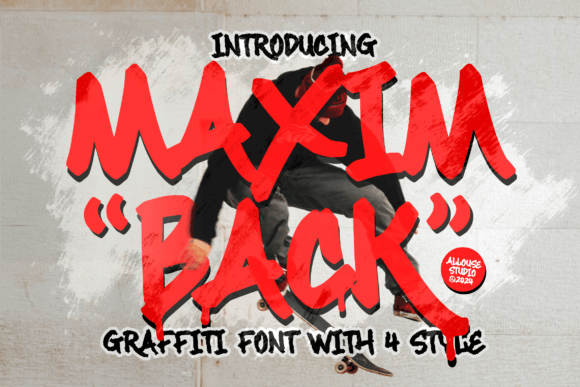
If you've ever spent hours tweaking a label, repositioning text on a wedding invitation, or second-guessing whether your sticker font will cut cleanly on your Cricut—then you know how much weight the right display font carries in handmade product design. Maximback isn’t just another graffiti-style typeface—it’s a thoughtfully crafted, commercially flexible font built for makers who need impact *and* practicality. With four distinct styles (Regular, Bold, Outline, and Shadow), it gives you real design control without sacrificing that raw, expressive energy graffiti typography is known for.
What makes Maximback stand out in my shop—and on my shelves—is how well it balances attitude with legibility. The letterforms are bold and slightly irregular, with confident angles and open counters that hold up beautifully at small sizes. I’ve used it for ¾-inch candle labels (cut flawlessly on my Silhouette Cameo), 5x7 wedding welcome boards (where guests actually paused to read the full phrase), and even as a focal point on 12x12 printable wall art—no pixelation, no awkward spacing, just clean, confident presence.
For physical product creators, Maximback shines where first impressions matter most: packaging, tags, and signage. Its strong vertical rhythm and generous x-height mean it reads clearly on matte kraft paper, glossy sticker stock, or distressed wood signs. I recently updated my line of herbal tea blends using Maximback Bold for the flavor names—paired with a soft serif for origin details—and saw a measurable uptick in Instagram saves and “Where’d you get those labels?” DMs. Customers don’t just see a font—they sense intention, craft, and brand confidence.
It’s especially effective for short, high-impact phrases: “Hand-Poured,” “Small Batch,” “Made With Love,” or “Est. 2022.” Because Maximback is a display font, it’s not meant for body copy—but that’s exactly why it works so well for product names, collection headers, and decorative accents in digital printables. On planner inserts or printable checklists, I use Maximback Outline as a subtle header over lighter sans serif text—it adds hierarchy without overwhelming. For holiday-themed SVG files (think “Merry & Bright” mugs or “Cozy Season” tote bags), the Shadow style adds instant dimension in mockups—and cuts cleanly when layered in design software.
Readability matters—not just for customers, but for your tools. Maximback’s consistent stroke weight and generous spacing prevent common cutting-machine headaches. No tight inner joins to snag, no ultra-thin terminals that vanish at 12pt. I tested it down to 8pt on matte vinyl stickers (3” round)—still fully legible under natural light. That reliability means less test-cutting, fewer wasted materials, and faster turnaround when fulfilling Etsy orders.
Font pairing is where Maximback truly becomes versatile. Think of it as your expressive anchor—then build around it. For rustic wedding stationery, I pair Maximback Regular with a warm, low-contrast serif like Cormorant Garamond for ceremony programs. For modern boutique tags, I combine Maximback Bold with a crisp geometric sans like Montserrat Light. And for social media graphics or digital downloads? Maximback Outline + a friendly handwritten font (like Quicksand or Pacifico) creates contrast that feels intentional—not chaotic. It never competes; it commands attention, then steps back.
All four styles come in OpenType format (.OTF), with full Latin character support—including accented characters for Spanish, French, and German listings (a lifesaver for international Etsy buyers). There are no hidden ligatures or swashes that clutter your glyph panel, but the set includes smart stylistic alternates for key letters (like a dynamic ‘A’ or ‘R’) that add subtle personality when you want it. No extra downloads, no confusing file naming—just drag, install, and go.
As a small shop owner who sells physical products, printable templates, and SVG bundles, licensing clarity is non-negotiable. Maximback is a commercial font with an extended license included—meaning you can use it freely on merchandise (t-shirts, mugs, enamel pins), client projects, digital downloads (Canva templates, Procreate brushes with text elements), and even printed product packaging—no attribution required. Just keep your original font files secure, and you’re covered. That peace of mind lets me focus on designing—not lawyering.
I reach for Maximback when I need something that feels handmade but looks professionally polished—like chalkboard lettering with precision, or street art with structure. It works for farmhouse markets and urban pop-ups alike. I’ve used it for baby shower invitations (“Tiny Human, Big Joy”), seasonal candle collections (“Spiced | Smoky | Still”), and even as a signature element on my own shop banner—where it subtly tells customers, *this isn’t mass-produced. This is made with care.*
Real talk: Not every graffiti font translates well to product design. Some are too jagged for cutting machines. Others lose charm at small sizes. Maximback avoids both pitfalls. It’s expressive enough to reflect your creative voice—but engineered enough to serve your business. Whether you're printing 500 labels for a wholesale order or designing one-of-a-kind wedding signage, this display font delivers consistency, character, and quiet confidence—every single time.
So if your current go-to font leaves you adjusting kerning for 20 minutes—or worse, second-guessing whether your customer will even *see* your product name—give Maximback a try. Install it. Type “Handmade with Heart.” Resize it. Print it. Cut it. Then watch how much more your work says—before a single word is read.